Showing posts with label children. Show all posts

Wednesday, 4 November 2015

"Every Child Wild": The Wildlife Trusts' Campaign to Reconnect Children with Nature

When I was volunteering in the visitor centre of RSPB Pulborough Brooks recently, two young girls came bursting through the door with pink cheeks, big grins and a bug pot clutched tightly in their hands. They rushed up to me and held the pots up saying "Look what we found!" Their enthusiasm was infectious and had me grinning away with them. I peered inside each pot to see a red beetle and a small spider but, since my insect/arachnid fact pool is pretty sparse, I couldn't tell them specifically what they had caught. Despite this, the girls remained giddy with excitement, showing me what they had ticked off on their spotting sheets while they had been on the reserve. They both went home with stickers, still laughing and talking animatedly about what they had seen. I was left glowing in the knowledge that there were two more children who got close to nature, learnt something and took away a wonderful experience.
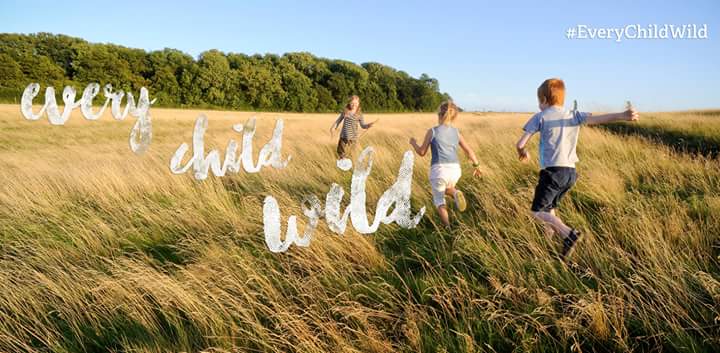
Connecting children with the natural world is one of the challenges of our modern, technologically-advanced world and it's one that is close to my heart. It's also very close to the heart of The Wildlife Trusts who today launched their new campaign "Every Child Wild". Their goal is all in the name: to get every single child in touch with nature in some way. On the campaign page of their website (visit this link: www.wildlifetrusts.org/EveryChildWild) they say:

"Children are happier, healthier and more creative when they are connected with natural world. This should be an option not just for a few, but for every child in the UK."

It seems like an obvious concept but, unfortunately, it would appear that there is a severe lack of "wild play" in the lives of children nowadays. As we all know, there is a lot of focus around smart devices and many kids spend most of their time staring at a screen of time kind, both at home and at school where tablets are being introduced more and more as a learning tool. Of course, there are plenty of benefits to using these devices for learning but too much screen time is preventing children from getting fresh air, exercise and from experiencing the wildlife on their doorsteps.

The Wildlife Trusts commissioned a report this year to find out exactly where children and nature stand together and they came back with some worrying statistics. They said that 27% of 8-15 year olds had "never played outside by themselves, beyond their house or garden" and of those children, 37% had not played outside in the past 6 months. When I think back to when I was that age, I have clear memories of spending the warmer evenings playing games on the local green with the neigbouring kids, having water balloon fights and constructing unfeasibly long daisy chains. In fact, the memories that have stuck in my head are the ones I spent outside. 

Naturally, parents face a number of worries over letting their children play outside, busy roads and stranger danger being two of the biggest. Green spaces are much less abundant now, with so much housing development going on, and for those children living in more urban areas, finding an outdoor place to play is even trickier. That's why a campaign like "Every Child Wild" is so vital. It's working hard to get round the challenges of modern Britain and find new and exciting ways for kids to involve themselves with wild activities. 
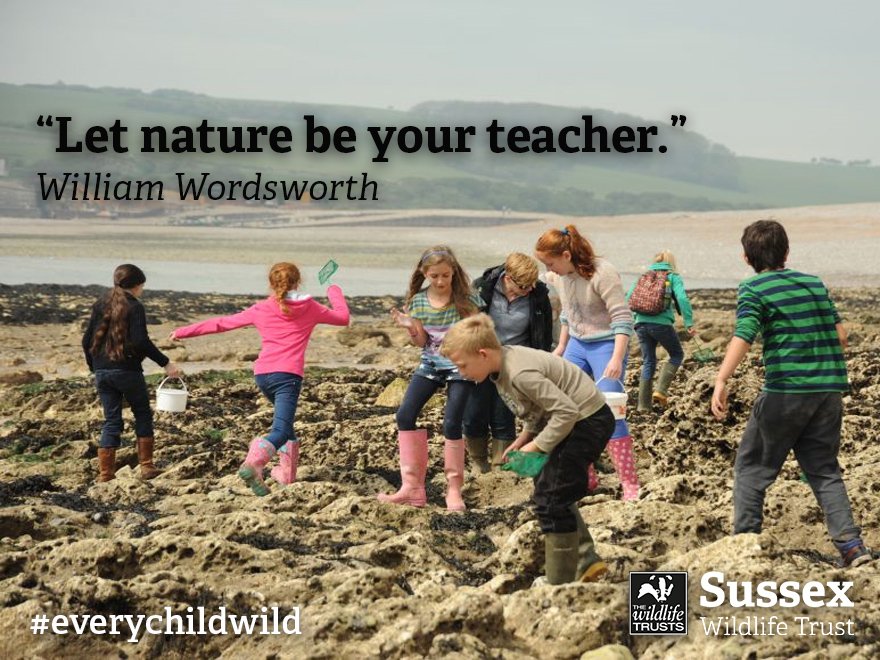
A big part of this campaign is targeted at schools. Children generally spend five out of seven days of the week at school, so a large percentage of interaction with nature has to be undertaken there. The Wildlife Trusts are already reaching 300,000 school children each year but there are 500,000 still to be reached. In the Trusts' report, they found "only 24% of children said their school had an indoor nature display area like a nature table" and just half of children said they have a nature area outdoors. More of an emphasis needs to be put on nature at schools, so that they can develop a proper respect for the environment and discover new and exciting facts about wildlife; this is where the conservationists of tomorrow will be inspired.

The importance of encouraging children to get outside cannot be stressed enough. There are so many benefits to connecting with nature, not only for young people but for all ages; both physical and mental health can be vastly improved, as well as knowledge. The "Every Child Wild" campaign is working to inspire children, parents and teachers together through nature clubs, reserve visits and plenty of fun ideas to have a wild adventure! The image of myself and my brother running through woods filled with bluebells, dragging around huge sticks and getting covered in mud when we were little is one that I'll always have. Children of this generation need similar images of their own so that they can look back when they're older, as we do, and remember what nature meant to them. 

You can follow the campaign on Twitter using the hash tag #EveryChildWild and share your own thoughts and ideas there too. 

Saturday, 19 September 2015

Great British Beach Clean in Goring


There have got to be worse ways to spend a Saturday than strolling along a beach in the blazing sunshine while looking after the environment at the same time. For me, it doesn't get any better. Today was my beach clean up event for the MCS Great British Beach Clean weekend. I have held two other clean ups at this beach this year and I was fortunate enough to have fantastic teams of volunteers for both. Today's team was no exception!

In total, there were 25 of us scanning the length of the survey area, including five under-18s. I'm always extremely pleased to have young people taking part in these cleans, particularly when I see that they are enjoying themselves. Getting children and teenagers interested in their environment is absolutely vital and events like these are a brilliant way to make learning about nature into something fun and engaging. Of course, I love to have volunteers of all ages taking part! I spoke to several of the adults helping me today who all expressed amazement at what gets washed up on the shores and dropped by the public. It fills me with hope whenever I come across people who care as much as I do about looking after our planet.


As there were so many of us, it didn't take us long to cover the 100m survey area. Much like the clean I did back in June, there wasn't a massive amount of litter to be collected, not in terms of weight anyway. Generally, Goring-by-Sea is a pretty clean beach from first glance but once you really start looking closely at the pebbles and in between the groynes, all of the small pieces of twine, fishing line and plastic start appearing. One of the teams recorded a large piece of carpet, which we were all hoping had not been used for disposing of anything untoward! The same team also found a large, plastic receptacle that looks as if it was used as a marker buoy. I picked up my first shoe; it was a Croc, so no great loss there! (Please don't take offense if you're a Croc-wearer! Each to their own...)


The last time I was down at Worthing, I nearly got blown off my feet by the strength of the breeze so I came prepared today with my rain mac. I would have been better off dressed in a swimming costume I think, so I could have had a quick dip in the sea to cool off! It was absolutely roasting today and there was quite literally not a breath of wind. I'm certainly not complaining but it was most unexpected, especially after the lack of summer we've just had. 

Several of my volunteers expressed interest in the results of our collection and what the data gets used for, as well as when I will be holding future events. Beach-cleaning is such a great way to not only do some good for the environment but also to get some fresh air and exercise. Living on a small island as we do, none of use are ever too far away from some form of coastline and if we could all pick up litter each time we visited a beach, it would make the world of difference. 

The results from today's clean were as follows: 

-32 metal items
-32 sanitary items
-38 paper items
-20 wood items
-539 plastic items
-21 rubber items
-32 cloth items

Friday, 6 March 2015

"For blackberry, read Blackberry"

During a scroll through my Twitter newsfeed this week, I came across an article that I found rather alarming and I know I'm not alone in my reaction. According to this article from The Guardian, the Oxford Junior Dictionary has had a 50-word cull of terms relating to nature in an attempt to make the revised edition more relatable to the "modern child". Words such as "acorn" "otter" "newt" and "heron" have been removed to make way for "broadband" "chatroom" and "database". 

Granted, in a dictionary containing 10,000 entries, 400 of those are related to the natural world but that's not the point. We live in a time where the majority of the first-world population owns at least one hand-held digital device and information is accessible without lifting more than a finger. This does NOT mean that the natural world is any less important and therefore any less worthy of teaching to our children. Surely, at the age of seven, children have more of a need to know about the wildlife they might encounter on their walk to school or while playing in the garden than being able to explain what the definition of a "celebrity" is. 
There lies the biggest problem though. Children are spending less and less time outside exploring, playing and exercising in the fresh air. Many would rather stay inside on laptops and tablets than kick a ball around a field or climb a tree. The decision to remove 50 words related to nature from the OJD is a reflection of this changed attitude. However, as I type this there are endless initiatives, such as Project Wild Thing, underway to try and encourage children to spend more time outdoors, not only to get them more interested in nature but to dispel the ongoing threat of childhood obesity. Of course there is a balance between technology and nature but in the state we are currently in, the latter holds more importance for a seven year-old child, in my opinion. 

"...we should remember that the Junior Dictionary may be one of the few dictionaries a child will ever encounter, and that the selection will influence his or her use of language for life." Henry Porter, the Guardian 

I can perhaps understand slightly outdated words being given the elbow, but "raven" "tulip" and "catkin"? Even in this modern digital era, these things still exist and children referring to this dictionary will not have access to a definition for any of these terms; instead these seven year-olds will be able to define "celebrity" "database" and "democratic". These aren't words that take precedence at such a young age, surely? 

 "The Oxford Dictionaries have a rightful authority and a leading place in cultural life. We believe the OJD should address these issues and that it should seek to help shape children’s understanding of the world, not just to mirror its trends" Laurence Rose, RSPB 

There's been quite a bit of outrage expressed online over the decision to remove so many relevant words from the OJD. Part of the defence from Oxford University Press is that the environment that children grow up in has changed: they are living in more urban and suburban areas, rather than open countryside where they might encounter various animals, plants and flowers. However, this to me is even more reason for them to be made aware of these words, because what is education if not to inform us about things we have never seen?

 I don't currently have any children but should I be fortunate enough in the future, I would 100% rather they know what a conker is over a chatroom.


Image credits:

www.rspb.org.uk
www.salamtoronto.net/?p=18419