Showing posts with label environment. Show all posts

Tuesday, 5 January 2016

Out with the old (patch) and in with the new!


It all happened rather fast after an extremely long process; my parents and I are now living in Midhurst. We moved from our Southwater house exactly a week before Christmas (!) and into the place my mum and step-dad bought together in the beautiful historic town of Midhurst, found smack-bang in the middle of the South Downs National Park.

Given the option, I don't think I would have chosen to move away from where we were before. I was so spoilt by the rural location of our cottage, being fully immersed in nature and not being able to look out of the window without seeing some form of wildlife. I talked about this in my guest post for A Focus On Nature but, in a nutshell, living in Southwater and immersing myself in the natural world were the reasons I decided to pursue conservation as a career. I have had some amazing experiences in that quiet corner of West Sussex.

Our old back garden bordered a huge expanse of woodland and so we had all sorts of creatures visiting the feeders. I discovered the undeniable quirky character of the nuthatch, now my favourite garden bird, and was treated to frequent close sightings of great-spotted woodpeckers, including a male and female pair feeding their two juveniles on the peanuts. We regularly had goldcrests hopping about in the bushes, the occasional visit from goldfinches, long-tailed tits and bullfinches, the odd treecreeper clinging to the oak tree and even a couple of redwing stopped by briefly on their way through. I think the most exciting sighting I had was actually one of the last before we moved, seen from the kitchen window, and that was a firecrest!


In the three years we lived there, we had five different species of bird nesting in the garden, though not all with successful broods. The first year the nestbox went up, the blue tits moved in straight away and their chicks fledged with success, spending the next couple of weeks using our feeding station to learn how to feed. At the same time, a few metres above the box, a pair of nuthatches spent weeks lining a hole in the oak trunk with mud until it was only big enough for the parents to fit through and then flew back and forth with food for their chicks. I didn't see them fledge so can only hope they did so successfully.

 The following year the great tits decided it was their turn in the box and the same thing happened; I saw a flock of juvenile great tits on the feeders and made the assumption that they had come from our box. Elsewhere in the garden, a female blackbird had decided the hedge next to our kitchen was the perfect place to build her nest, and I spent many moments at the window watching her return with her beak stuffed with twigs and moss. She laid three eggs which all hatched, but sadly, the day after, they had disappeared from the nest. I put this down to either corvids or woodpeckers. In a separate bush at the same time, long-tailed tits built themselves an impressive ball of feathers, moss, horse hair and lichen. Unfortunately this didn't even see eggs as it was destroyed by a predator of some form before the family returned to lay any.


I explored quite a bit of the woodland surrounding our old house where I had some close encounters with roe deer on several occasions. The first one was with a doe and her very young fawn, so young it still had its spots. I remember holding my breath and not moving a muscle from where I was stood, while my heart beat wildly in excitement. We frequently had deer crossing in front of the house too and so I was often able to watch them from the front garden. I always felt grateful to be so close to such beautiful animals in the wild and still do.

I also built a mini wildlife pond not long after we first moved in. I would have loved to construct a full-sized one with plants but the house (and garden) were rented so that wasn't an option. It didn't seem to bother the local amphibians that my pond was only small; I had both toads and frogs frequent it right up until the last few weeks, when there were two resident frogs living under the pile of rocks surrounding it. 


It's actually quite difficult to look back on three years worth of experiences and remember each and every one in perfect detail. The big ones have stuck with me, naturally, but there were others that would have just become blurry in my memory if I hadn't have blogged about them. I'm definitely going to be better with recording what I see, hear etc. if only so that when I move away from this patch eventually, I'll be able to look back as I'm doing now and recall everything over and over.

The feeling of leaving was bittersweet. I was worried that moving to a slightly more suburban area, albeit with a small patch of woodland behind the house, would mean less variety of garden birds. I have absolutely nothing against blue tits and starlings, as many of you will know from this article I wrote back in October , but I knew I would miss seeing the nuthatch and woodpeckers especially! 

It turns out I didn't need to worry. The first bird I spotted after moving in was a goldcrest! And not a goldcrest in the distance through bins. Nope, this was in a small tree in our neighbours front garden, about 6ft from our window. I took that to be a good sign. Since then we've had goldfinches and long-tailed tits on the feeders, a song thrush in the front garden and two great-spotted woodpeckers fly over, chuck-chucking as they went. It's looking like this patch won't be letting me down any time soon.

Wednesday, 25 November 2015

Think Before You Let Go: the Dangers of Releasing Balloons

I was asked by Emma Websdale, creator of "Rants for Change", if I wanted to film a 2 minute rant on a subject I am passionate about and want to see change in. Now, there are a whole host of areas that I would very much like to see changes made in so it took me some time to decide which one to focus on but in the end, I went with helium balloon releases. You can watch the video below but there is a whole lot more I have to say on this subject, so do please read on!


Unbelievably, releasing balloons is not currently classed as littering because they're not being directly dropped on to the ground. That to me sounds like the most ridiculous piece of legislation, as if whoever passed it forgot that such a thing as gravity exists on our planet and, as the old saying goes, "what goes up must come down". The Marine Conservation Society is one of the organisations working hard to get this changed and to ban all intentional releases of balloons and paper lanterns in the UK. I think there is a lot of ignorance surrounding this issue, particularly when it comes to the biodegradable aspect.

A quick Google search for biodegradable balloons brings up producers claiming that their latex balloons are 100% natural and will break down within six months or "as fast as an oak leaf in your back yard". Six months is a long time and leaves a huge window of opportunity open for wildlife to consume the latex debris. Just because the balloons explode into tiny particles at a particular altitude does NOT mean they instantly become harmless to animals. Those particles, however small, have to land somewhere and wherever that is, there will be some form of living creature drawn to the colours of the pieces and tricked into consuming them.

It's a sensitive subject when the occasion being marked with balloons or lanterns is the passing of a loved one. Understandably, families and friends want to do something special and memorable to say goodbye to the deceased but is the best way to do that really by organising a mass-littering event? When it comes down to it, that's all a balloon release is. Just because the objects are going up instead of down doesn't change the outcome. As I say in my video, people may as well dump a whole load of plastic on the ground and walk away because that's where the balloon debris will end up eventually, a tempting yet deadly meal for some unsuspecting animal. I'm certain no loved on of my mine would want to be remembered in this way.

Balloon release
A balloon release marking the vicitims of Shoreham air crash in August www.itv.com 

Perhaps grieving communities could be partially forgiven. However, huge corporations can in no way be pardoned. ITV's popular talent show The X Factor is one such example of a company that should know better. To mark the first episode of this year's series back in August, the show televised a mass-release of red balloons. I actually haven't watched the show for a couple of years but I just happened to catch a clip of this balloon release online and thought it was a new thing they did this year. After some more searching, I came across the below clip posted on YouTube which was filmed at the Birmingham auditions two years ago, suggesting that hundreds of balloons are being let loose by the X Factor team in each of the audition cities every year. That equates to thousands of balloons. 


Around 7.6 million people watched the opening episode this year and a huge percentage of viewers are teenagers and young adults who follow along with the events of the show eagerly each year. In my mind, the ITV and show's producers are are extremely irresponsible to give off the impression releasing balloons like this is acceptable. They should be showing consideration for the environment and setting an example, not completely disregarding the science that categorically states any form of litter poses an enormous risk to the natural world.

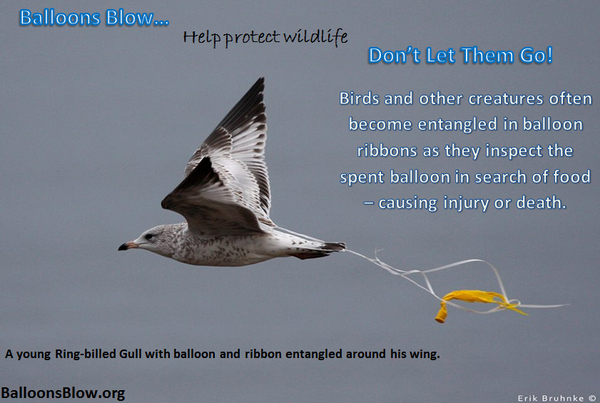
So let's talk about what those risks actually are. As I mentioned earlier, a latex balloon takes six months to biodegrade. That gives wildlife around 180 days to eat the fragments that drop to the ground. Plenty of time to do plenty of damage. Obviously plastic and latex contain absolutely no nutritional value for animals, so the energy they expend consuming the materials is wasted. Some animals don't even get as far as swallowing the remnants; instead, they get pieces tangled around their mouths and beaks, preventing them from eating anything at all and resulting in them starving to death, a truly horrific way to die. 

The ribbons are just as bad as the balloons themselves as these can get wrapped around feet, rendering the animal helpless, and often they struggle so much to get free that the ribbon eventually cuts into their skin, giving them nasty wounds that can lead to limbs becoming partially or wholly detached.  Balloons don't only have an effect on the terrestrial environment. Those fragments that don't land on the ground end up in the ocean where marine mammals, such as seals and turtles, and seabirds will eat them. It is estimated that 90% of seabirds have plastic in their stomachs. That kind of statistic is sickening and shows just how much of an impact we humans have on wildlife.


www.balloonsblow.org
I am grateful that, so far, I haven't come across any injured or dead animals during my beach clean ups. That being said, I have picked up countless pieces of balloon and ribbons from Worthing beach and I have wondered what damage the missing pieces have done elsewhere. These occurrences are 100% preventable if the people responsible for organising releases put an end to any future events. There are many other ways to mark special occasions or to show you are thinking of a loved one, without causing any damage to the natural world. 

Many councils across the UK have already banned balloon and paper lantern releases on their land. However, there are still many, many more that have yet to do so. Click this link to see if your council has already banned the release of balloons and lanterns and if they haven't, get in touch with them, via Twitter, Facebook or email, to ask them why and persuade them to reconsider. My council isn't on there, so I intend to get in touch and voice my opinion. I hope you will do the same.