Showing posts with label self criticism. Show all posts

Sunday, 11 January 2015

Take Two

Yesterday, I shared my first completed portrait of 2015 on my Facebook page. It is of my aunt's cat Twinkle and was quite a challenge as her fur is flecked with orange and white so it took some real concentration. At the forefront of my mind while I was working on it was the fact that I've drawn her before, when I very first started doing pet portraits in 2012. In fact, I was working from the same photograph that I referenced for the portrait the first time around, so I was keen to compare the two pieces once I was finished, to get a sense of how I have progressed in two years. 
On the left is the most recent version and on the right, the 2012 piece. It makes me cringe to look at the older piece, because I'm so self-critical. My style was very different; much looser and certainly less detailed. It's a good exercise, though, to see how much I have developed my skills since then, however difficult I find it to look back. 

Of course, I still have plenty of space for improvement and I'm hoping that in another two years time, I will have honed my technique even more. 

Monday, 3 February 2014

Technology in Art

I often get asked "do you draw from life or do you use photographs?" Now, I feel slightly ashamed to admit this but I have never been particularly good at drawing from life. Correction: I've never thought I was good at drawing from life. It goes back to my self-critical gremlins who delight in sitting on my shoulders while I try to sketch what I see, and whispering behind their hands, laughing at my attempts to be loose and free with my drawings. 

When it comes to pets though, my reasons are purely practical. To start with, I know from experience that animals are damn tricky to draw in the flesh, as they are prone to unpredictable movement. Said experience is taken from the few times I have attempted to draw my cats while they are looking adorable and content in sleep; my theory is that they have some kind of camera/sketchbook sensor built in so the SECOND you start to draw or try to take a photo, they move. The same applies when they are snoring and I want to take a video-they don't wake up this time, they simply stop making the cute noises and I'm just filming a sleeping cat like some kind of feline stalker!

Anyway, I digress. Quite a lot. I don't draw pets from life because they are prone to movement and the last thing I want is to get started on a drawing and to find them rearranging themselves into an entirely different pose. Of course, if they are awake, that's a whole other story, at which point preventing excessive movement is near impossible. Especially for over-excited puppies! Yes, I could make quick sketches of them and then take my own photos for reference later, but that's simply not how I work. 

From another practical point of view, I offer my services to customers all over the country AND all over the world, so to draw from life/take my own photographs would mean narrowing my potential market to an extremely localised area. So no, I don't draw the pets from life. I use photos provided by the customer, whether that be a single one or 50 different shots.

Initially, I would print the photos out to the size I would be working at and refer directly to that. It meant that all the important details (e.g. the eyes, nostrils, certain markings) were correctly proportioned for me to take reference from. I have since progressed from this technique, actually after I was gifted a Kindle Fire for Christmas 2012 (thank you kindly, Dad!) and have discovered the wonders of zooming in!
Zooming in is truly wonderful, when compared to a static photo on paper that you have to peer at with squinted eyes if you want to see tiny details. There was honestly no going back after I started drawing from my tablet but it made me really think about the use of technology in art today. Obviously computers are highly prevalent in all types of art and fields such as graphic design and illustration have progressed a great deal with the use of computer programs and digital drawing. 

I often consider how I would work if I were an artist in an era before tablets, computers and cameras were even invented. There would HAVE to be sketches made, lots and lots of them, and the entire piece would depend on the quality of these sketches as I wouldn't be able to take photographs for reference later. I certainly wouldn't be drawing portraits of dogs in New Zealand, unless I was to take a very long journey, by boat, to work there. I really do find it amazing how accessible technology is nowadays and it has completely altered the way we live, in every respect. 
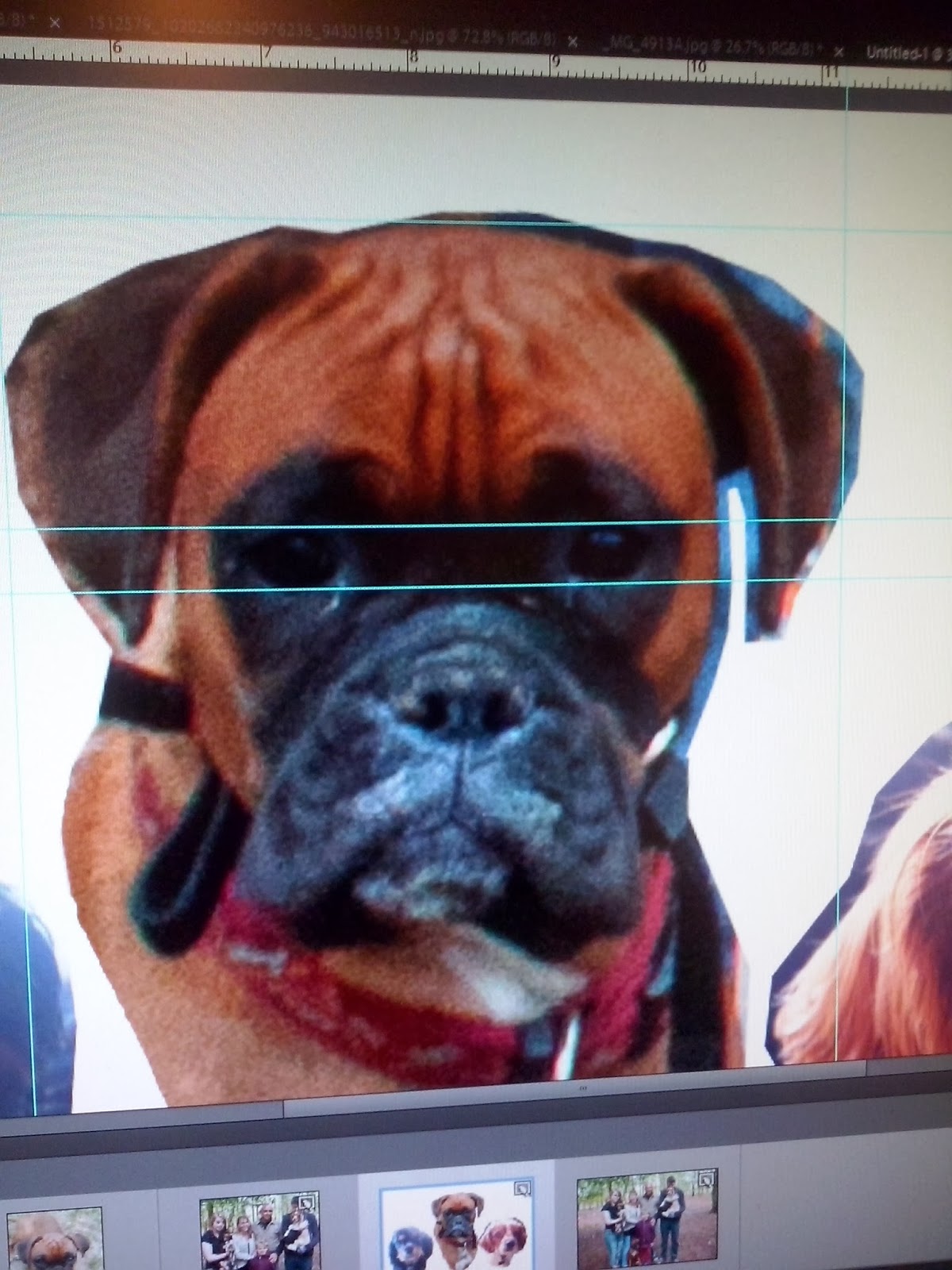
I have recently started using Photoshop to make my initial drawings. I don't mean physically drawing using PS, just having the photo blown up to the correct size and drawing from the screen. I have always done my mock-ups using PS but I've been trialing this new technique to maximise the accuracy and likeness of the first sketch, as it is in my eyes the most important part of the process. 

I am always terrified of that very first pencil stroke, I will happily admit that. If the initial drawing isn't perfect, then you can guarantee that the likeness of the pet isn't going to be correct. I spend a lot of time getting the drawing right so I'm always looking for ways to assist me and improve the process. In a nutshell, I have started using reference lines on the mock-up to create anchor points on the page, so I only have to measure the same distance on my paper to know exactly where I need to draw each element. 

Essentially, it echoes the very old technique of drawing a grid across your page and working square-by-square. I don't follow this exactly, but the concept is the same and it has really helped me. I used to be happy enough to free-hand it and tweak bits as and when I needed to, but actually I'm saving a lot of time and upset by following this new way of plotting the piece out. 
As wonderful as this is and as much as I have found it helpful, I can't help feeling like technology has made art lazy. Or perhaps this is the wrong way to look at it? I suppose there is still a certain level of skill required to understand the shape of a subject and how to replicate it on paper, we have just found new tools to help us. Compared to an old master using piles of sketches as reference, we use photographs and instead of using an old-fashioned grid system, I'm using digital anchor points. No, it isn't laziness, it is development and progress. New tools in a new era. 

Perhaps I should have a go at drawing one of our cats from life. I might find that my style, technique and process will be entirely different when faced with something that is likely to move and can't have lines dragged across it! I am constantly at war with myself over technology. A lot of the time, I hate how much time we all spend online, myself included but at the other end of the argument, I really do rely on gadgets for my work. 

I can't help wondering, what would it have been like to be an artist in a technology-free world?

Wednesday, 22 January 2014

Progress in a Short Time

I recently put together a time-lapse video of my work, using footage from one of my very first portraits. It was great fun and really simple to do, and I think it is a good alternative way of showing my process, instead of the static images I normally use.
I can't TELL you how much I cringed while making it though! The reason for said cringing was entirely down to my technique in the footage, or lack thereof. I find it incredible that my skills have progressed quite so much in such a relatively short period of time and looking at that footage has made me realise how much I have learnt in the last year or so. My style has become a lot more detailed and since starting to apply base layers, I have been able to achieve much more depth and texture within each portrait.
For instance, the above piece is the very first portrait I ever did. I had never done one before so had no particular technique to follow; I was somewhat winging it. The customer was very pleased with it and felt it was a true reflection of the two dogs' characters which is great but looking at it now, there are some things I would definitely change. I made no allowance for mounting/framing and the style to me seems a lot more cartoonish than my current style. I would love to have another crack at the same dogs, to apply the skills I have picked up. 

Using another example shows my progression in an even clearer light. 
2012

2013

The first photo is the portrait I worked on in the time-lapse and the second piece is a very similar one that I completed for Christmas 2013. The most noticeable change to me is the fact that I don't use black ink anymore. I still use white ink for the final highlights; it is something of a signature thing for me which I have been doing since 2012, as I love to pick out the twinkle in the eye or the shine on the nose and the bright white ink helps me do that. However, I no longer use the black ink to bring out the darker areas. I have to say, I'm glad I stopped using it! The more recent portrait has a much more realistic quality about it which pleases me.

I'm supremely grateful that I have been given enough opportunity to progress my skills; if my lovely customers didn't keep booking with me, I'm not sure I'd be able to improve as swiftly as I have done and I only look forward to making even more improvements in the coming year!

Saturday, 18 January 2014

Self-criticism and learning to take compliments.

I hold my hands up and happily admit that I am far too hard on myself. It has been pointed out to me by friends and family many times before and I am well aware of it, but it very much comes with the territory of being an artist.

With each piece of work I do, I go through a rollercoaster of feelings; I will start off quite liking the piece, then it will suddenly look very, very wrong at which point I have learnt it's best to take a break and come back only when my frustrations have lessened. I generally get off the rollercoaster feeling pleased with what I've created (although on very few occasions this isn't the case!) and this process repeats itself with every new piece.

When I'm at my low point, there is nothing anyone can say to me that will convince me what I'm doing isn't complete rubbish. I work through it and I come through the other side.

What I struggle with the most is accepting compliments. This applies to my personal life as well as my professional and I'm sure I'm not alone! I never know what to say when someone tells me my work is good; I even struggle with the obvious "thank you". It's not so bad when it's online as I can quite happily reply without feeling ridiculously awkward but when it's in the flesh, even with close family, I really, really can't handle it.

For example, on Thursday I went to a friend's birthday meal, armed with a portrait of her two dogs that I had spent the previous week working on without being able to share any progress shots for fear of her seeing it. I was excited to give it to her as she loves her dogs and I'm one of those people who finds great delight in giving people gifts.
So she opened it and was delighted, then passed it round the table for everyone to look at. All the while this was happening, I felt supremely awkward and had to suppress the overwhelming urge to busy myself on my phone so I didn't have to see the reactions of my friends. Silly really!

Why do I react that way? I was pleased with the piece; in fact I really enjoyed drawing it, so I'm struggling to get my head around why I find it so hard to share in everyone's admiration. Maybe it's because sharing something you have put so much into, emotionally and physically, is scary. You're making yourself vulnerable and open to criticism.

Actually, I have a slightly worse example. My step-mum commissioned me to draw her sister's westie for Christmas just gone, and naturally I accepted. This was before I remembered that I would in fact be there with them on Christmas day, so would see her opening it-but wait! That's not all! The westie in question would ALSO be there on the day, as he couldn't be left alone for long periods of time.

To recap; I would be drawing a portrait of a step-relative's dog, would be in the room as she opened it and the subject of said portrait would also be in the room, available for direct comparison.

Now, that may not seem like a situation worthy of panic to you, but to me, it only seemed to treble the normal levels of pressure I deal with when drawing someone's pet. Needless to say, when the day came and the portrait was unwrapped, it was warmly received and Snowy was more interested in tripping people up than looking at his likeness, but I STILL managed to feel uncomfortable, even more so because this time it wasn't a gift from me, I just happened to be the artist. So saying "you're welcome" in response to the thanks didn't seem appropriate to me.

I don't think my self-criticism will ever go away. It may well improve a little with time but I'm sure you fellow creatives can sympathise with me when I say that it comes with the job.

On the subject of fellow creative folk; do you suffer with same problem? How do you deal with it?

I would love to hear from you, if not only to make me feel better about my crippling lack of self-confidence!